
INSIGHTS / PERSPECTIVE
Why Companies Need Decision Systems Now.
AI has made it much easier to gather information. Choosing what to do with it is still specific to each company. What gets checked, who decides, and what the company learns from the result now need to remain part of the business itself.
PURPOSE SELECTOR
Choose the purpose closest to yours
The right starting point depends on the purpose. Are you building a service for customers, or helping your own teams carry judgment forward? Choose the path closest to what you need now.

ALBACONNECT Editorial Team

The day before an executive review, a business leader is laying out the numbers. Revenue is growing. Margin is falling. Churn is rising. Should the company increase acquisition spend, change the offer, or stop investing?
The data is there, but the decision does not move. It returns to one question: “How does the CEO see it?”
What is missing is not another dashboard. It is a company decision system: a way to retain what the business is trying to achieve, which conditions matter, who may make an exception, and what must be reconsidered after execution.
The More AI Spreads, the More the Decision System Matters
AI can summarize information, generate options, and make forecasts or recommendations. That is precisely why a company must know what it values before it receives the recommendation. Without that, AI can make a decision look more certain while leaving its premises unstated.
Imagine that AI recommends increasing ad spend. Revenue forecasts alone cannot settle the question. How much margin must be protected? Can churn be treated as temporary? What are the cash constraints this quarter? At what point can the business leader act, and when must the question go to the executive team? Data becomes a decision only through the company’s own purpose, constraints and criteria.
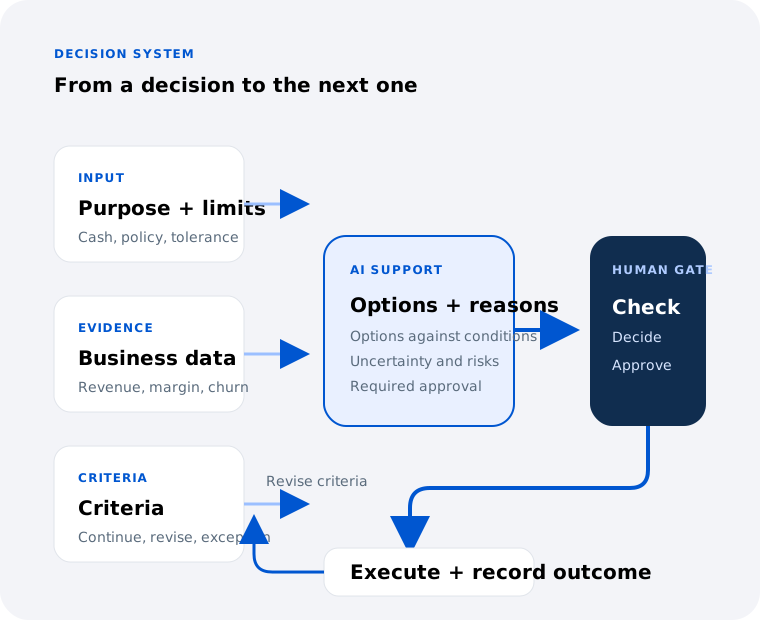
A decision system is not a mechanism for AI to replace an executive. It is a company foundation that connects internal and external data, business knowledge, purpose, criteria and constraints so that AI and people can evaluate choices, execute a decision and improve the next one from the result.
Most Companies Have Information, But Not a Way of Deciding
BI shows what happened. ERP records transactions and operations. AI agents can retrieve material, propose a path and complete work. All of these are useful.
None of them alone decides what to choose under a given set of conditions. A dashboard reflects reality but does not set priorities. A recommendation may sound plausible but does not say who can allow an exception. Automation may move quickly, but if the purpose is wrong, it simply scales the error.
Making decisions faster does not mean removing approval. It means sharing evidence, authority, exceptions and outcomes in advance, so people focus on the situations that actually need judgment.
A Decision System Holds Speed and Accountability Together
Speed and care appear to conflict. In practice, everything slows down when no one knows how far they are allowed to decide.
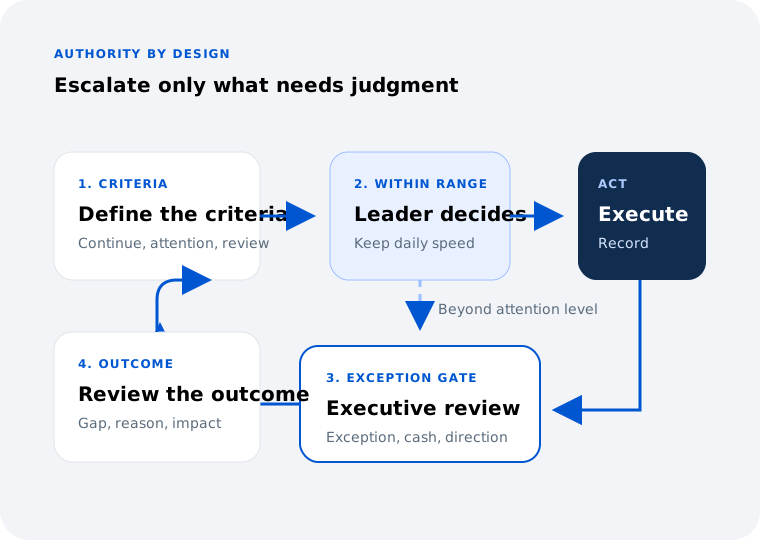
For an investment-continuation decision, four things should be designed before the meeting:
- Purpose: whether growth, margin, retention or cash capacity is the priority for the period
- Criteria: what levels of which measures mean continue, change terms or reconsider
- Authority: the range a business leader may decide and the conditions that escalate to executives
- Outcome: what is recorded after the decision and when the criteria themselves are reviewed
With those connections in place, AI can say more than “increase investment.” It can say: “The current case meets the continuation condition, but churn exceeds the agreed attention level. Expanding the investment requires an executive review.” The person still makes the choice. But they no longer need to reconstruct the premises from memory each time.
What Matters Most Is What Stays With the Company
Generative-AI models and tools will change. Today’s preferred model may not be next year’s.
What a company must retain over time is its purpose and constraints, the language used in its work, decision criteria, exceptions, approval history and outcomes. When these are connected, the center of judgment stays with the company even as models and interfaces change.
At ALBACONNECT, we call this semantic layer SemanticOS: the core that makes purpose, meaning, constraints, criteria, relationships and outcomes usable by AI and work applications. ALBA ONE is the platform for building and operating a company-specific Decision OS on that core.
Do Not Start With an Enterprise-Wide AI Platform
You do not need to standardize every decision in the company first. Start with one decision that has material impact, keeps reaching a particular person, and produces an outcome that can later be examined.
It might be investment continuation, discount approval, a response to a strategic customer, or a change in dispatch or vessel allocation. Put the current material, tacit criteria, exceptions, authority and outcome record beside one another. AI comes after that. If the company does not first define what the system is meant to decide, more conversations and automation will not accumulate its judgment capability.
How ALBACONNECT Can Help
ALBACONNECT supports the construction and operation of company-specific Decision OSs. With ALBA ONE as the common platform, we design the full loop: framing the target decision, connecting data and business knowledge, presenting options and reasons with AI, human approval, execution and outcome review.
You do not need to begin with an AI implementation discussion. Start with one question: “Which decision cannot move until someone specific is asked?” We can then work with you to identify what should remain with the company and which scope should become a system.
Discuss building a decision system
Editorial note
The investment-review scenario is hypothetical and illustrates the structure of a decision system. It does not describe an implementation, performance result or autonomous optimization for a particular company. The definitions of Decision OS and ALBA ONE follow ALBACONNECT’s published design materials.
01 / CUSTOMER-FACING
How do you make a decision-support service useful in a customer’s real work?
The goal is not to produce more AI answers. It is to give customers a range in which they can decide with confidence. Separate the shared service from each company’s own criteria and authority, and the offering becomes easier to use and improve.
- What to standardize first
- Separate the work that can stay common from the criteria and authority that change for each customer.
- What the customer retains
- Make it clear why a recommendation appeared, who approves it and where human judgment begins.
- How the service changes
- Keep improving one service without rebuilding it from scratch for every customer.
01 / START WITH A DECISION
Start with the decision the service should help move forward
A generic chat interface makes the value of a decision-support service hard to define. Start with who uses it, in which operation, and for which decision: credit, price, investment continuation, dispatch or a response to a strategic customer. Once the decision is explicit, the needed information, exceptions, approvers and outcome record become visible.
The offering boundary should be a promise that a person in a defined role can make a decision under defined conditions with defined evidence. Without that, recommendation quality cannot be explained and every customer request becomes bespoke development.
02 / SEPARATE THE LAYERS
Separate what stays common from what changes by customer
Not everything should be standardized across customers. The business objects, the way options are presented, the evidence flow and the record format can form a common service core. What a customer prioritizes, which exceptions it allows and who holds final authority should remain customer-specific.
This separation makes a service repeatable without taking judgment away from the customer. ALBA ONE can support the design that connects a shared structure with each company’s own meaning, constraints and criteria, so that work applications can use them.
03 / MAKE THE BOUNDARY VISIBLE
Make recommendations, approvals and exceptions easy to follow
Customers need more than a conclusion. They need to see why a recommendation was made, which conditions are missing and who should approve it. AI can prepare options and reasons; people decide within their authority. Making that division visible is what allows a service to enter real operations.
Exceptions belong in the service design as well. Define who handles unexpected cases and how their results inform a review of the criteria. This is not a design that gives every decision to AI. It deliberately retains human intervention where it matters.
04 / OPERATE THE LEARNING LOOP
Use real outcomes to improve the service
Once a service is operating, customers will introduce new exceptions and conditions. Treating each one as a stand-alone request erodes the service boundary. Recording which condition changed a decision, who changed it and what outcome followed turns experience into material for improving the shared operating model.
Usage volume is not the only measure. A durable service lets customer and provider both explain the range of decisions it covers, the conditions that require a hold and the cases that require approval.
05 / BEGIN WITH ONE SERVICE DECISION
Start with one customer operation
There is no need to sell a company-wide AI platform first. Choose one operation with material impact, a need to explain the decision and an outcome that can later be examined. Put the current data, criteria, exceptions, authority and outcome flow side by side.
Then decide which parts belong to the common service and which become customer-specific configuration and operation. This is the starting point for turning one-off AI development into a decision-support service that can be provided continuously.
A useful decision-support service does more than give a smart answer. It helps customers understand the reason and move forward with their own responsibility intact.
02 / INTERNAL OPERATIONS
How can veteran judgment become something the whole team can use?
Experience does not transfer through a manual alone. Start with what the veteran checks, where they hesitate and who they consult. Then turn those observations into practical points the team can follow and improve.
- What to systematize first
- Connect the conditions, exceptions and consultation routes a veteran uses to everyday cases and customer data.
- What remains with the company
- Keep the reason and the result, so another person can check the same points and move the work forward.
- How the operation changes
- Send only the ambiguous cases to the right expert instead of asking them about everything.
01 / FIND THE DEPENDENCY
Find one decision that stops until a particular person is asked
A response to staffing constraints does not require automating every operation. Start with one decision that repeatedly stops until a particular veteran is asked: an urgent discount, a quality exception, a priority customer response or a schedule change. It contains conditions and thresholds that have not been made visible.
Do not stop at calling this dependency. Observe what the person actually checks: the documents, the people consulted, the conditions that cause a hold and the situations that require speed. That makes the judgment worth carrying forward concrete.
02 / TURN EXPERIENCE INTO CONDITIONS
Keep experience as things to check, not fixed answers
Turning a veteran’s words directly into rules will not keep up with changing reality. What needs to be retained is the relationship between purpose, conditions to check, exceptions, authority and evidence. The boundary for holding a case and escalating it is part of the design.
A new operator can then follow what must be checked instead of memorizing an answer. AI can help prepare information, compare evidence and propose options with reasons. Final judgment and exception approval remain with accountable people.
03 / DESIGN THE HUMAN GATE
Send only the uncertain cases to the expert
A decision system is not designed to remove people. It separates cases that can proceed within a normal operating range from those that need review because they affect loss, safety or an important customer relationship. Veterans and managers can then focus on the cases where their intervention has real value.
The aim is not to add approval steps. It is to send a case for approval with its evidence already assembled. The operator records what was checked, and the approver records why an exception was allowed. Responsibility remains clear without stopping the flow of work.
04 / LEARN FROM OUTCOMES
Let the criteria grow from real outcomes
Decision criteria are not finished once written. Customers, markets, supply and staffing change. Review the outcome, retain why it differed from expectation and treat repeated exceptions as a signal to revisit the criteria rather than as extra effort for an individual to absorb.
This is what makes the system more than a manual. The organization can accumulate operational knowledge while different people inspect the same premises before acting. The capability needed under staffing pressure is an organizational learning loop, not a larger individual memory.
05 / START SMALL
Start small and test it in real work
There is no need to collect all company knowledge first. Choose one judgment that concentrates on a particular person, matters to the operation and produces an outcome that can later be examined. Make the materials, conditions, exceptions, approver and outcome record visible.
Then design what AI can prepare, what people must check and what should be recorded for the next review. Starting small avoids imposing an abstract rule on the field and lets the criteria develop through actual outcomes.
The aim is not to replace veterans. It is to make their judgment usable by the team, so their time can go to the cases that truly need it.