
INSIGHTS / PERSPECTIVE
Turning the Criteria Behind Decisions into an Organizational Asset.
“Do we take this job, or pass?” When two similar inquiries end differently, the difference is the company’s criteria. We explain how to move those criteria out of one person’s head and into a form the company, its people and AI can use.
ALBACONNECT Editorial Team

Two similar inquiries arrive. One is accepted, the other declined. The same person decided both.
60-day payment terms. Within the default criterion.
120-day payment terms. A director must approve any exception.
Illustrative only. A real decision also checks credit standing, track record and other relevant facts.
What produced the difference was not how the jobs looked, but the conditions that person checked in their head: payment terms, track record in the same type of work, distance to the site. Which conditions, in which order, and how far each can bend. That way of deciding is what the company should own.
In most companies it has never been written down. As a result, only one person can make the decision.
Why People Still Ask One Person, Even With ChatGPT or Codex
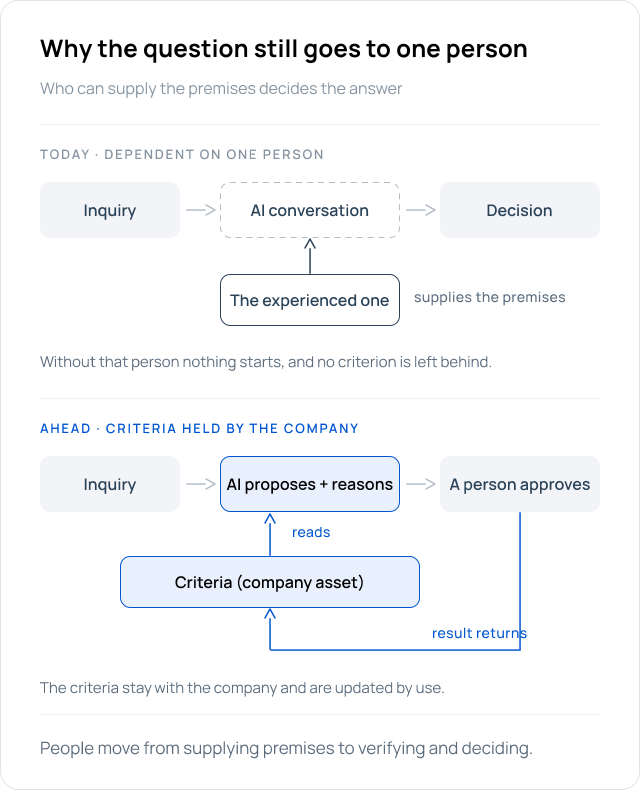
ChatGPT and Codex help organize conditions and propose options. They can also retain conversations and working instructions.
The question still goes to one person because the premises are supplied out loud, every time. “We normally decline anything over 90-day payment terms.” “Unless it looks like repeat business.” Those sentences are what make the answer useful.
So the arrangement depends on someone who can supply the premises. When that person is away, colleagues do not even know what to tell the AI. The conversations remain, but the company’s criteria cannot be lifted out of them and reused.
A Criterion Becomes Transferable When Split Into Five Parts
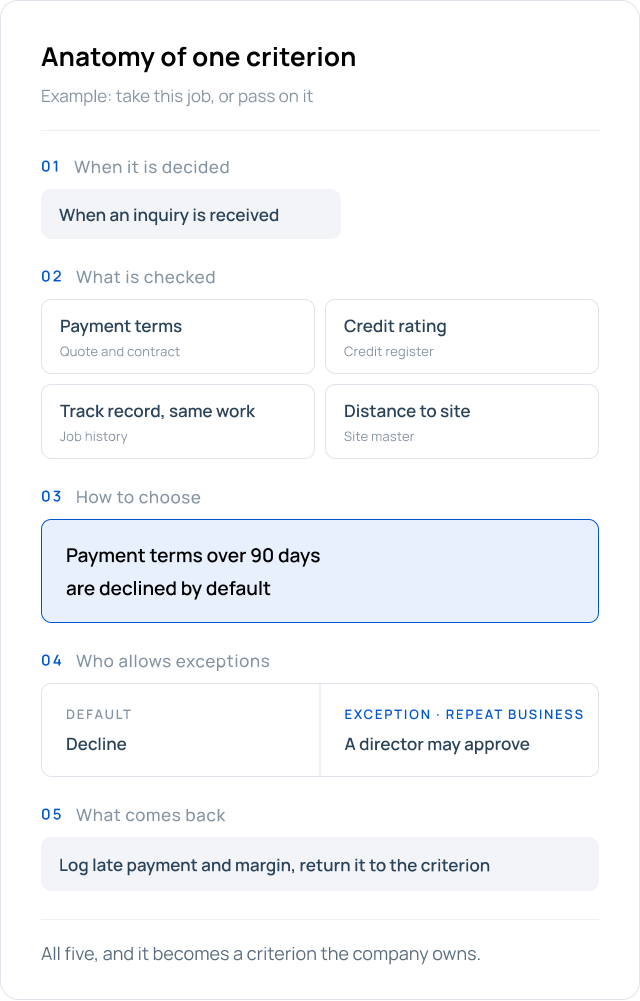
“Decline anything over 90-day payment terms” is not yet usable on its own. When is the decision made? What is checked? Who may allow an exception? Only with all of it can someone else decide the same way.
Using the inquiry above, the parts look like this.
- When it is decided: when an inquiry is received
- What is checked: payment terms, credit rating, track record in the same type of work, distance to the site
- How to choose: decline by default when payment terms exceed 90 days
- Who allows exceptions: with likely repeat business and an adequate credit rating, a director may approve acceptance
- What comes back: record late payments and margin, and review whether the criterion held
With that in place, the AI answer changes. Instead of “we recommend accepting,” it can say:
Payment terms here are 120 days, which falls under the default decline. However, there are three completed jobs of the same type and repeat business is likely. Accepting this as an exception requires director approval.
The conclusion arrives together with the criterion it was measured against, so the person receiving it can verify and decide.
Shared Vocabulary Is What Lets Criteria Accumulate
Write criteria down one by one and the same words keep appearing: payment terms, credit rating, type of work, repeat business. If each department means something different by them, nothing accumulates.
So the things a company deals with — jobs, customers, types of work, staff — and the relationships between them are defined in a shared structure. That body of definitions is an ontology.
With it, each criterion attaches to something specific: it is clear which customer and which field “over 90-day payment terms” refers to. The next decision reuses the same vocabulary. Every criterion added adds to the company’s assets.
The point is not to preserve every past practice as correct. A responsible person confirms when a criterion applies and whether it still holds.
Criteria Are Updated While They Are Used
Criteria written once and left alone are abandoned in practice. The working cycle is this.
AI presents options and reasons against the criteria. A person verifies and decides. Results — payment, margin, incidents — are recorded. Where a decision went wrong, the reason is examined and the criterion is revised.
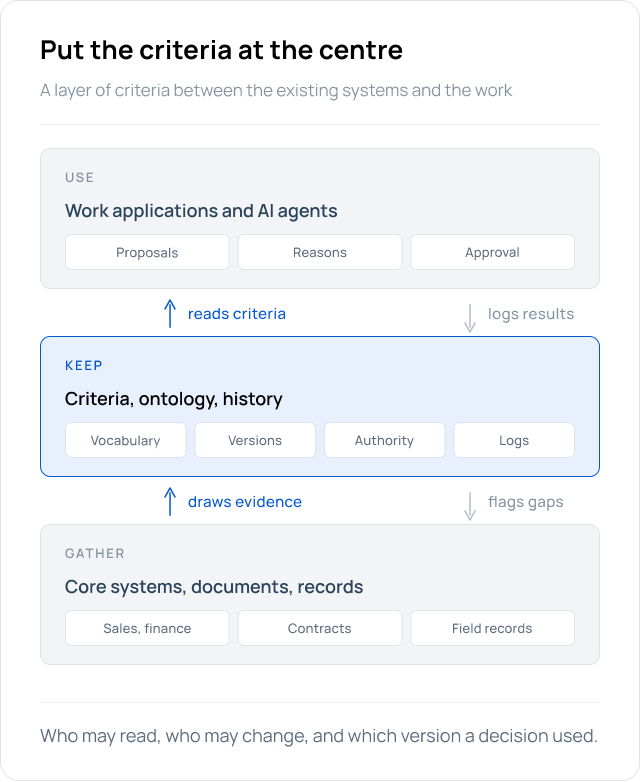
Company-wide use also requires recording who may change a criterion, when it takes effect, and which version a given decision was made under. Being able to explain a past decision by the criteria of its time is what serves both handover and audit.
Whether it works is assessed by time spent going back and forth, the number of reversals, and the outcomes of the decisions themselves.
ALBACONNECT Helps Build Your Criteria Into a System
ALBACONNECT supports building these decision-support systems. ALBA ONE provides the common foundation.
We draw out your criteria and put them into words, gather the required information from existing systems, connect it to the interfaces your team uses, and design the path by which results return to the criteria.
You do not need to change the whole company at once. Start with one decision that keeps reaching the owner. Split that one into five parts and begin with a small system in which AI proposes and people approve. Scope, integration with existing systems, cost and schedule are set after reviewing current operations and available information.
“Only that person knows how to make this decision.” Tell us about that specific situation. We will help identify what the company should retain and where to begin.
References
OpenAI: Projects in ChatGPT / OpenAI: Working instructions for Codex. Features checked September 16, 2026. The acceptance scenario is illustrative, not a customer case study or evidence of results.